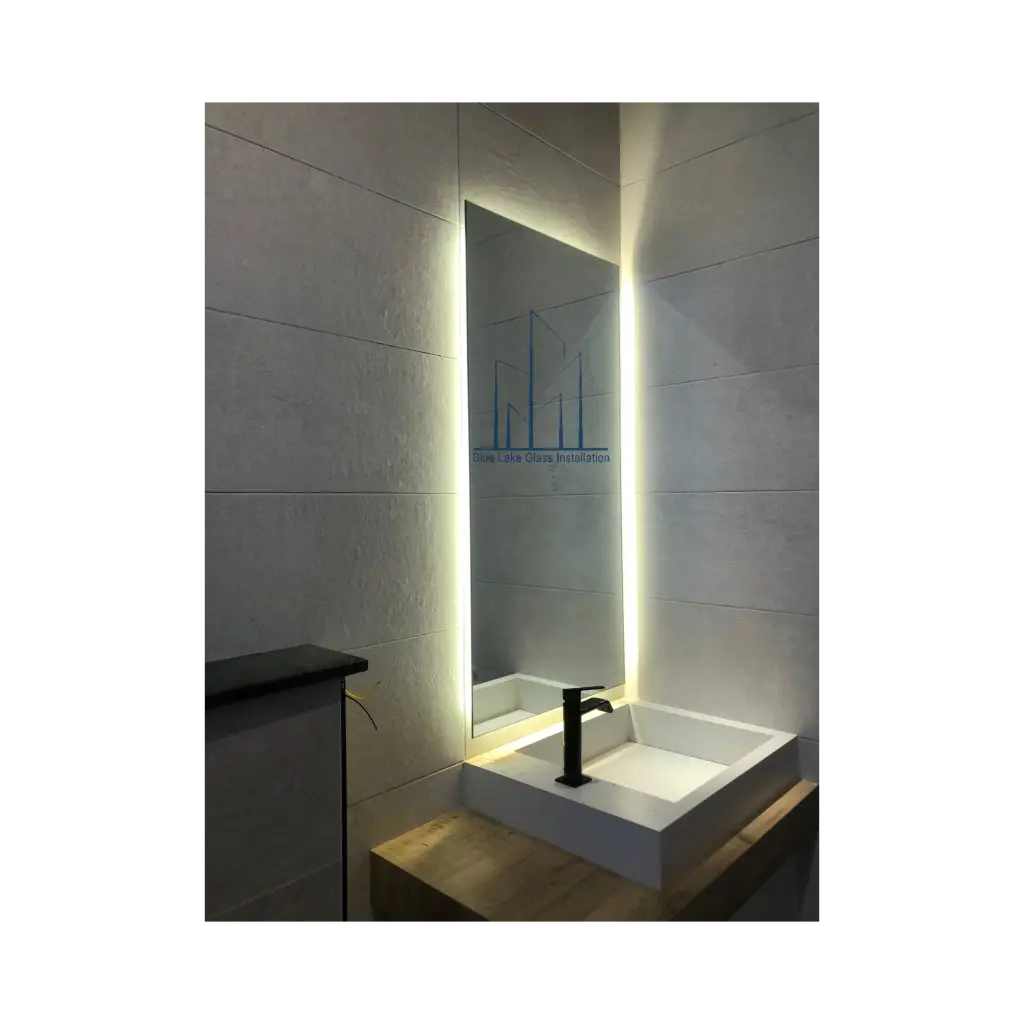
How to Choose a Custom Mirror in Dubai
LED, oval, full-wall, gym or decorative mirror? This guide explains how to choose the size, shape, finish, edge and installation style before ordering a made-to-measure mirror.

Choose a custom mirror around the wall and how the space will be used. Confirm the finished width and height, mirror shape, edge treatment, finish, lighting if it is an LED mirror, and the fixing method before fabrication. For large or full-wall installations, panel layout and access also matter.
A mirror can be one of the simplest-looking items in a room and still require surprisingly specific decisions. A few centimetres can change the balance above a vanity, a socket can interrupt a full-wall panel, and a decorative edge or custom shape has to be planned before the mirror reaches site.
Blue Lake provides custom mirror installation in Dubai for homes, bathrooms, gyms, offices and commercial interiors, including LED, gym, antique-style, decorative and oval mirrors.
1. Start with what the mirror needs to do
A bathroom vanity mirror, a full-height bedroom mirror and a gym wall are all mirrors, but they solve different problems. Before thinking about shape, decide whether the priority is grooming light, full-body reflection, making a room feel larger, covering a feature wall or creating a decorative focal point.
| Mirror type | Good for | Main design question | Extra detail |
|---|---|---|---|
| LED mirror | Bathrooms, vanities, dressing areas | Size and lighting position | Electrical point and wall preparation |
| Oval / round mirror | Vanities, bedrooms, decorative walls | Proportion to furniture or wall | Orientation and mounting height |
| Full-wall mirror | Gyms, studios, feature walls | Panel layout | Wall flatness, joints and access |
| Antique-style mirror | Decorative interiors | Finish and placement | How it works with surrounding materials |
| Custom-cut mirror | Unusual walls, niches, feature designs | Exact template or dimensions | Cut-outs, curves and edge finish |
2. Get the size right before choosing the shape
Custom sizing is one of the main advantages of ordering a mirror for the actual space. Instead of forcing a standard shop-bought size onto the wall, the proportions can be based on the vanity, furniture, ceiling height or feature-wall dimensions.
For a vanity, look at the width of the basin or cabinet and the available wall height. For a full-height mirror, check skirting, sockets, switches and nearby doors. For a large feature wall, decide whether you want one visual surface or several planned panels.
Useful rule: measure the finished wall, not an early construction opening. Tiles, stone, skirting and other finishes can change the usable size.
3. Rectangle, round, oval, arched or custom-cut?
Rectangular and square mirrors are efficient when you want to use a large percentage of the available wall. Round and oval mirrors soften bathrooms and bedrooms where the furniture and tiles already contain many straight lines. Arched and custom-cut shapes work when the mirror is intended to become part of the interior design rather than simply sit on the wall.

With non-rectangular designs, the relationship between the mirror and nearby fittings becomes more noticeable. Check the centre line, mounting height and how much space remains around lights, taps, shelves or decorative panels.
4. When is an LED mirror worth choosing?
LED mirrors combine the reflective surface with integrated lighting, which makes them useful in bathrooms, dressing rooms and grooming areas. They can also create a cleaner visual result than adding separate decorative lights around a mirror.

The electrical point should be planned with the final mirror position in mind. A beautiful mirror that hides the wrong connection point is a very expensive way to discover that electricity has opinions about interior design.
5. Mirror finish and edge treatment change the look
Mirror options can include clear, bronze, grey, antique-style and other decorative finishes. Clear mirror is the natural starting point when accurate everyday reflection is the priority, while tinted or antique-style finishes are more decorative.
Edges can also be polished, beveled or given another decorative treatment depending on the design. A polished edge keeps the detail simple. A bevel introduces an additional reflective border and can make the perimeter more visible.

6. Bathroom mirrors need to be planned around fittings
Bathroom mirrors often sit close to basins, taps, tiles, lights, sockets and cabinets. Those items set the real usable area. If the mirror is custom cut, any required cut-outs or unusual edge shapes should be confirmed before fabrication.
7. Gym and full-wall mirrors are about panel layout
For home gyms, fitness studios and commercial training spaces, a large reflected area is usually more important than a decorative individual mirror. That means the panel layout, vertical joints and finished height become key design choices.

Wall condition matters because large mirror panels make uneven surfaces and alignment issues more noticeable. Access also affects the practical panel size because the glass still has to travel through doors, corridors or lifts before it reaches the wall.
8. How can a mirror be installed?
Mirror installation can be wall-mounted, full-wall, vanity-based, feature-wall or commercial. Depending on the design, fixing can involve suitable mirror adhesive, mechanical support such as a track, or another method selected for the panel size and wall condition.
The important point is that the installation method should be decided before fabrication, especially for large or shaped mirrors. Weight, edge exposure and the condition of the wall affect how the finished mirror should be supported.
9. What changes the price of a custom mirror?
There is no useful single price for “a mirror” because the amount of material and fabrication can change dramatically between a simple rectangle and a large LED or decorative installation.
- Size and thickness. Larger mirrors use more material and are heavier to handle.
- Shape. Curves, arches and custom cuts require more fabrication than a standard rectangle.
- Edge treatment. Bevels and decorative edges add processing.
- Mirror type. LED and decorative finishes involve additional components or fabrication.
- Installation conditions. Wall condition, height, access and panel count affect installation work.
10. A practical custom-mirror process
- Share photos of the wall and the mirror style you like.
- Confirm the intended use and approximate dimensions.
- Measure the finished wall and note sockets, fittings and obstacles.
- Choose the mirror shape, finish and edge treatment.
- Confirm LED, cut-out or panel-layout requirements where applicable.
- Fabricate and install the mirror to the approved dimensions.
11. Common mistakes to avoid
- Choosing a shape without considering the wall proportions. A beautiful mirror can still look undersized or oversized.
- Ignoring sockets and switches. They matter before the glass is cut.
- Planning an LED mirror after the electrical work is finished. Connection position should be coordinated early.
- Assuming a large wall should use one huge panel. Access and installation may make a planned multi-panel layout more practical.
- Measuring before final tiles or wall finishes. Finished dimensions are what matter.
- Choosing only from an online photo. Size and placement should be adapted to the actual room.
Planning a custom mirror in Dubai?
See Blue Lake's mirror options or send a photo of the wall with approximate dimensions to discuss the size, shape, finish and installation.