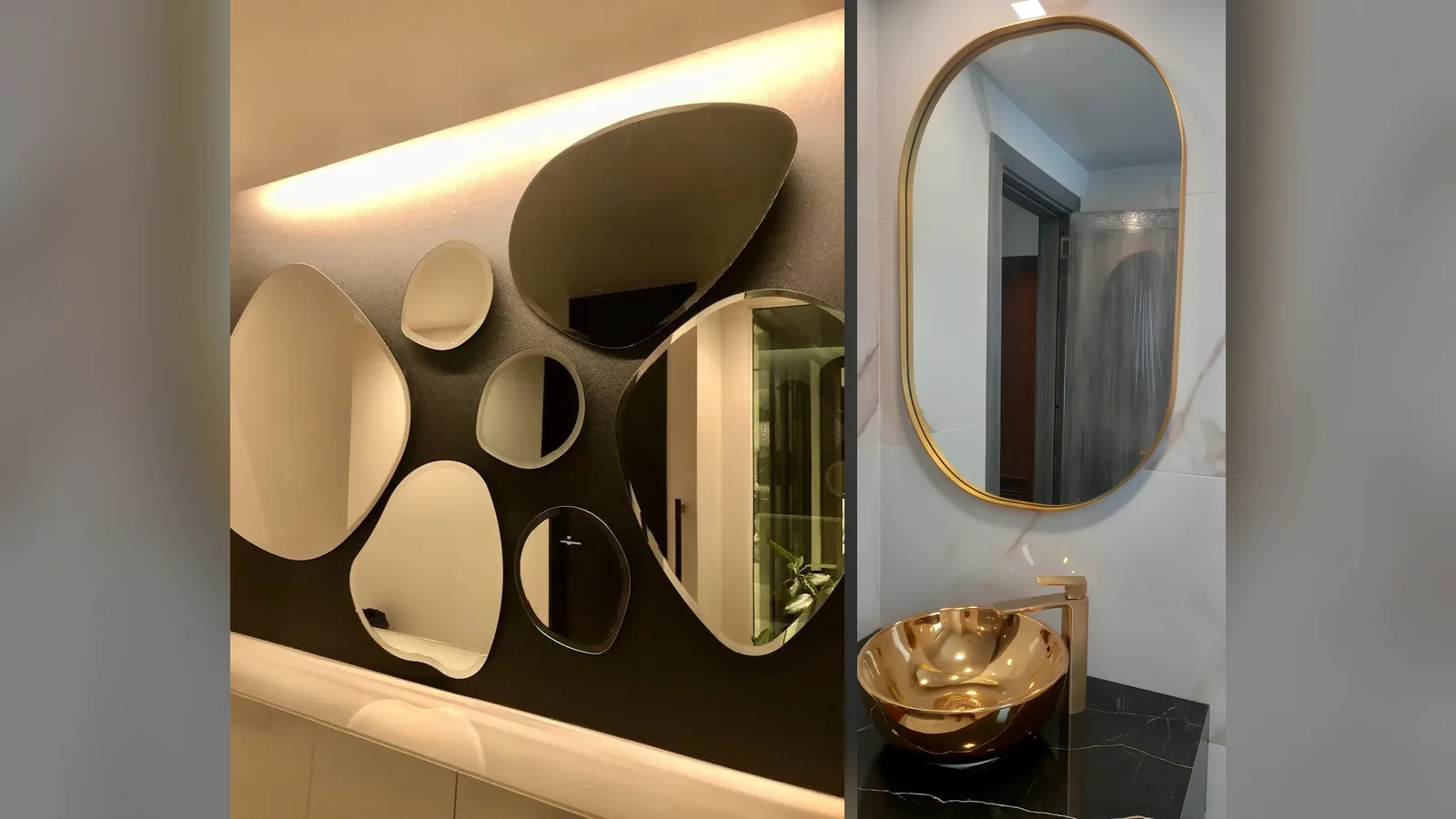
Choosing a framed or frameless mirror is one of the first decisions in any custom mirror project, and it changes more than the look. It affects how the mirror sits on the wall, how it handles humidity, how its edge is finished and how much attention it draws in the room.
Quick answer: choose a frameless mirror when you want the glass itself to be the feature and the wall around it to stay clean. Choose a framed mirror when you want the mirror to read as a decorative object that matches your joinery or metal finishes. In both cases, the final size, edge and fixing are confirmed around the actual wall.
What a frameless mirror offers
A frameless mirror shows only the glass and its edge. Blue Lake makes custom mirrors in rectangles, curved shapes and fully custom outlines, with polished or bevelled edges, so the glass can take almost any shape without a frame to follow it. That freedom is the main advantage: an organic cluster, a tall panel or a wall-to-wall sheet all stay clean and uncluttered.
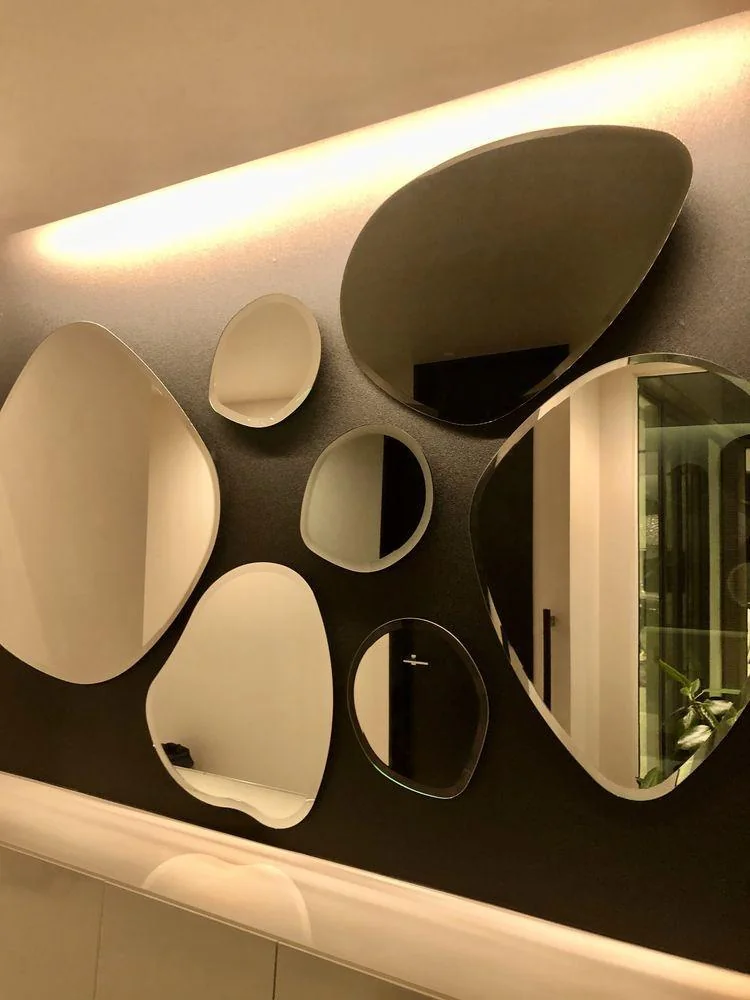
Because nothing frames the glass, the edge finish does the visual work. A polished edge looks plain and modern, while a bevelled edge catches light and adds depth. Our article on how to measure for a custom mirror shows what to record before you choose the shape.
What a framed mirror offers
A custom frame gives the mirror a stronger architectural edge. It can be coordinated with joinery, taps, handles and other metal finishes in the room, which is why framed mirrors are popular over vanities and consoles. The frame profile and finish are selected around the interior rather than taken from a fixed off-the-shelf size.
A frame also hides the cut edge of the glass, so the edge finish matters less. In a humid room, however, the frame material and finish matter a great deal, so ask how the frame will cope with moisture before you decide.
Framed or frameless: a side-by-side comparison
| Question | Frameless | Framed |
|---|---|---|
| Visual effect | Glass is the feature; light and open | Mirror becomes a decorative object |
| Shape freedom | Very high; shape follows the glass | High, but the frame must follow the shape |
| Edge | Visible, so polished or bevelled finish matters | Hidden by the frame |
| Matching other finishes | Limited to the wall and fittings | Frame finish can match taps, handles and joinery |
| Humid rooms | Check the edge and fixing | Check the frame material and finish |
Which rooms suit which style?
There is no rule, but patterns help. In a bathroom, a frameless mirror over the vanity keeps the room light, while a framed one can pick up the finish of the taps. For more on the vanity side, read bathroom mirrors in Dubai. In a living room, entrance or dining area, a framed or decorative mirror often works as a feature piece. In a bedroom or dressing area, a large frameless mirror can feel built in. If you want lighting as part of the mirror, look at LED mirrors, where the light is part of the design.
Edges, finishes and tint
Whichever style you choose, the mirror tone and finish also shape the result. Blue Lake lists clear, grey, bronze and antique mirror options, and the tone changes how warm or neutral the reflection looks. Antique mirror panels have a patterned finish that varies naturally, which is part of their decorative character. Choose the tone alongside the wall colour and the lighting in the room.
Fixing and wall conditions
A mirror is only as good as the wall it hangs on. The fixing method is selected around the wall, the mirror size and the project layout, and a flat, sound wall helps. Sockets, switches and fixtures can be planned as cut-outs after site measurement. Tell the person who measures about uneven walls, tiled walls and anything unusual so the right fixing is planned rather than assumed.
Ask for the schedule when you enquire. It depends on the measurement, the fabrication and the readiness of the wall, which is another reason to finish wall work before the visit.
What to decide before you order
- The final size and shape, including how it relates to the vanity, console or furniture beneath it.
- Frame or no frame, and for a frame, the profile and finish.
- For frameless glass, the edge finish: polished or bevelled.
- The mirror tone: clear, grey, bronze or antique.
- Any cut-outs for sockets, switches or fixtures.
- How the mirror will be fixed and whether the wall is ready.
Common mistakes when choosing
The most common mistake is choosing the style from a photo without checking the wall. A frame that looks right in a picture can overpower a small vanity wall, and a large frameless sheet can look cold in a room with no other reflective surfaces. A second mistake is ordering a standard size and forcing it to fit. Because Blue Lake makes mirrors to the dimensions the wall needs, you can let the space decide the proportions instead of the other way round.
Another mistake is ignoring what sits next to the mirror. Skirting, sockets, door frames and wall lights all affect the usable area, so note them before you settle on a width and height.
Everyday care for framed and frameless mirrors
Both styles clean best with a soft cloth and a non-abrasive glass cleaner. On frameless glass, pay attention to the exposed edge, where moisture can collect in a bathroom. On framed mirrors, wipe the frame separately so cleaner does not sit in the joints. In both cases, good ventilation in humid rooms protects the finish for longer.
Cost factors
The price of a custom mirror depends on its size, shape, edge, frame, tone and fixing. Prices start from AED 1,000. The final price depends on the size, design, materials, and installation requirements. To discuss your own space, contact Blue Lake and share photos and approximate measurements.
Frequently asked questions
Neither is better in general. Frameless suits clean, modern spaces where the glass is the feature, and framed suits spaces where the mirror is a decorative piece that matches other finishes.
Yes. Custom mirrors can be made in curved, rounded and fully custom outlines, and the edge can be polished or bevelled. Share your idea and the wall dimensions when you enquire.
They can be, if the frame material and finish are chosen for a humid room. Ask about moisture before deciding.
A flat, sound wall helps. Tell the person measuring about uneven or special wall types so the correct fixing method is planned.


