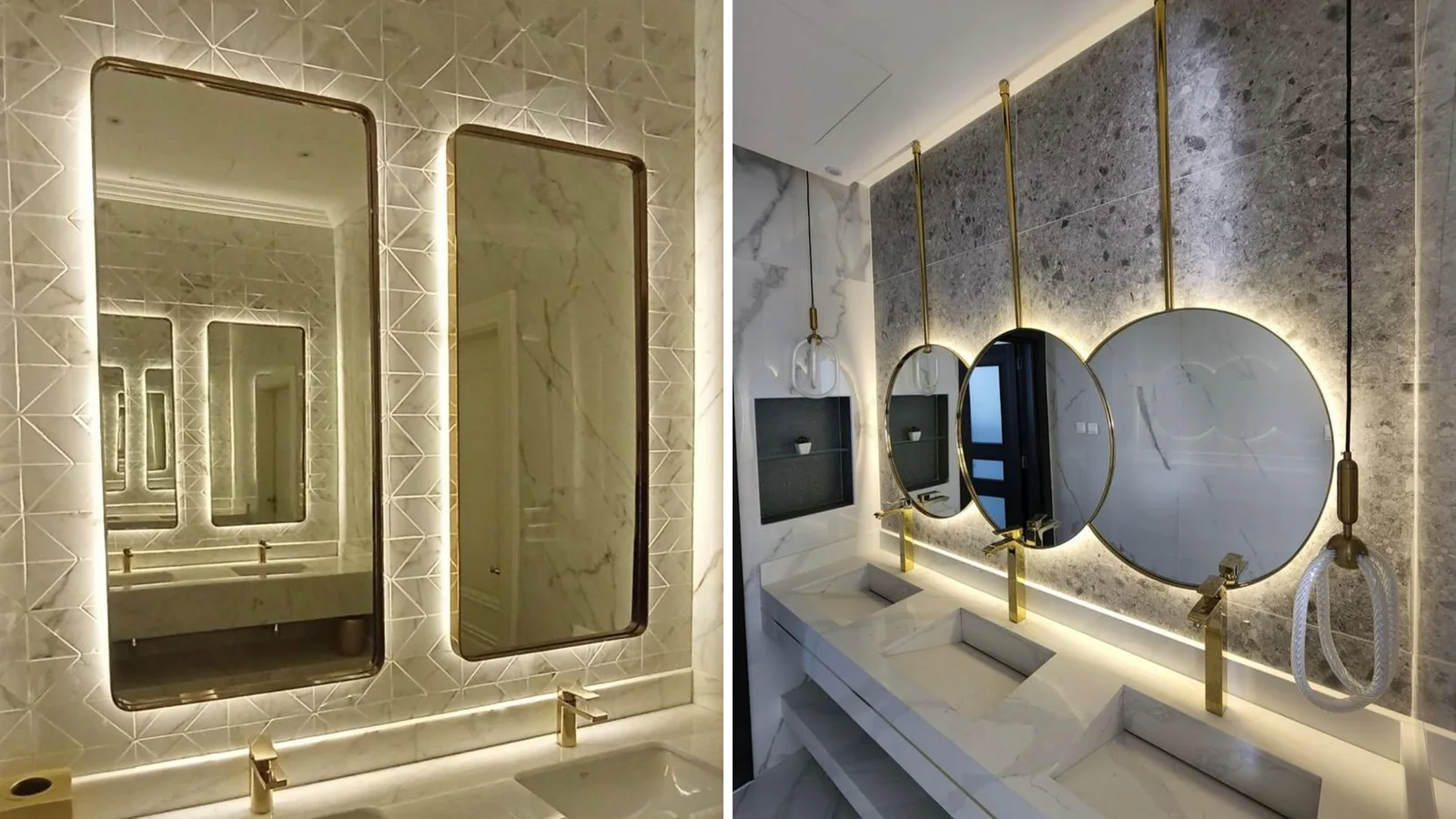
LED mirror light colour decides how your face, your tiles and your whole vanity look every morning. Two mirrors with the same size and shape can feel completely different once the light is switched on. This guide explains how to choose the tone, and how anti-fog and controls fit into the same decision.
Quick answer: choose a warm tone for a relaxed, hotel-style bathroom, a neutral white for everyday grooming and make-up, and a daylight tone when you want crisp, bright light. If you share the mirror or use it at different times of day, ask about adjustable colour. Add anti-fog when the mirror sits near a hot shower, and confirm touch, switching or dimming before fabrication.
What “light colour” means on an LED mirror
Light colour is usually described as colour temperature, or CCT. It is measured in kelvin (K). Lower numbers look warmer and more yellow. Higher numbers look cooler and more blue-white.
The names vary between suppliers. On our LED mirror service page, the options are described as Warm, White and Daylight. The exact LED specification is confirmed before the mirror is made, so treat the names as a starting point rather than a fixed number.
A simple way to compare the three tones
| Tone | Typical look | Often chosen for | Watch out for |
|---|---|---|---|
| Warm | Soft, golden glow | Guest bathrooms, powder rooms, relaxed evening use | Can make make-up and skin tones look warmer than in daylight |
| White (neutral) | Clean, balanced light | Daily grooming, shaving, make-up, family bathrooms | Can feel plain in a very warm, decorative interior |
| Daylight | Bright, cool and crisp | Dressing areas, task-focused vanities, modern white bathrooms | Can feel harsh at night or with warm stone and brass |
As a rough guide, warm light is often around 2700 to 3000 K, neutral white around 4000 K and daylight from about 5000 K upwards. Lighting suppliers do not all use the same bands, so ask what your chosen system actually uses.
How to choose the right tone for your bathroom
Start with how the mirror will be used, then check how the light works with your finishes. Here is a practical order of questions.
1. Is the mirror for grooming or for mood?
If you shave, apply make-up or check skin every day, neutral white is usually the safest choice. It shows colours more evenly than a warm glow. If the mirror is mainly decorative, warm light often feels more inviting.
2. What colours are the walls and fittings?
Warm light flatters beige marble, wood, brass and gold frames. Cool light suits white, grey and black schemes. Very cool light over warm stone can make the surface look flat or slightly green.
3. What other light is in the room?
An LED mirror is rarely the only light source. Match its tone to your ceiling downlights where possible. Mixing a cool mirror with warm ceiling lights is a common reason a bathroom looks “off” in photos and in person.
4. Who uses the mirror, and when?
A shared master bathroom often suits an adjustable option. One person may prefer a bright tone in the morning, while another prefers a softer light at night. Ask whether the selected LED system supports more than one tone before you decide.
Backlit glow versus a brighter lit border
The lighting style changes how the colour reads. A backlit mirror throws light onto the wall behind it, which creates a soft halo. The Blue Lake projects in the photos above use this style. Decorative LED designs can put more light towards the user.
A soft backlit glow is attractive in warm tones, but it gives less direct light on the face. If you need strong task light, consider a neutral tone, brighter ceiling lighting near the vanity, or both. Our LED mirror sizing and installation guide explains how the lighting effect, mirror size and electrical point are planned together.
Anti-fog: when a demister is worth adding
An anti-fog mirror has a heating pad, often called a demister, behind the glass. It warms the mirror slightly so steam does not condense on it as quickly. Blue Lake offers anti-fog as an optional extra, confirmed with the mirror specification before fabrication.
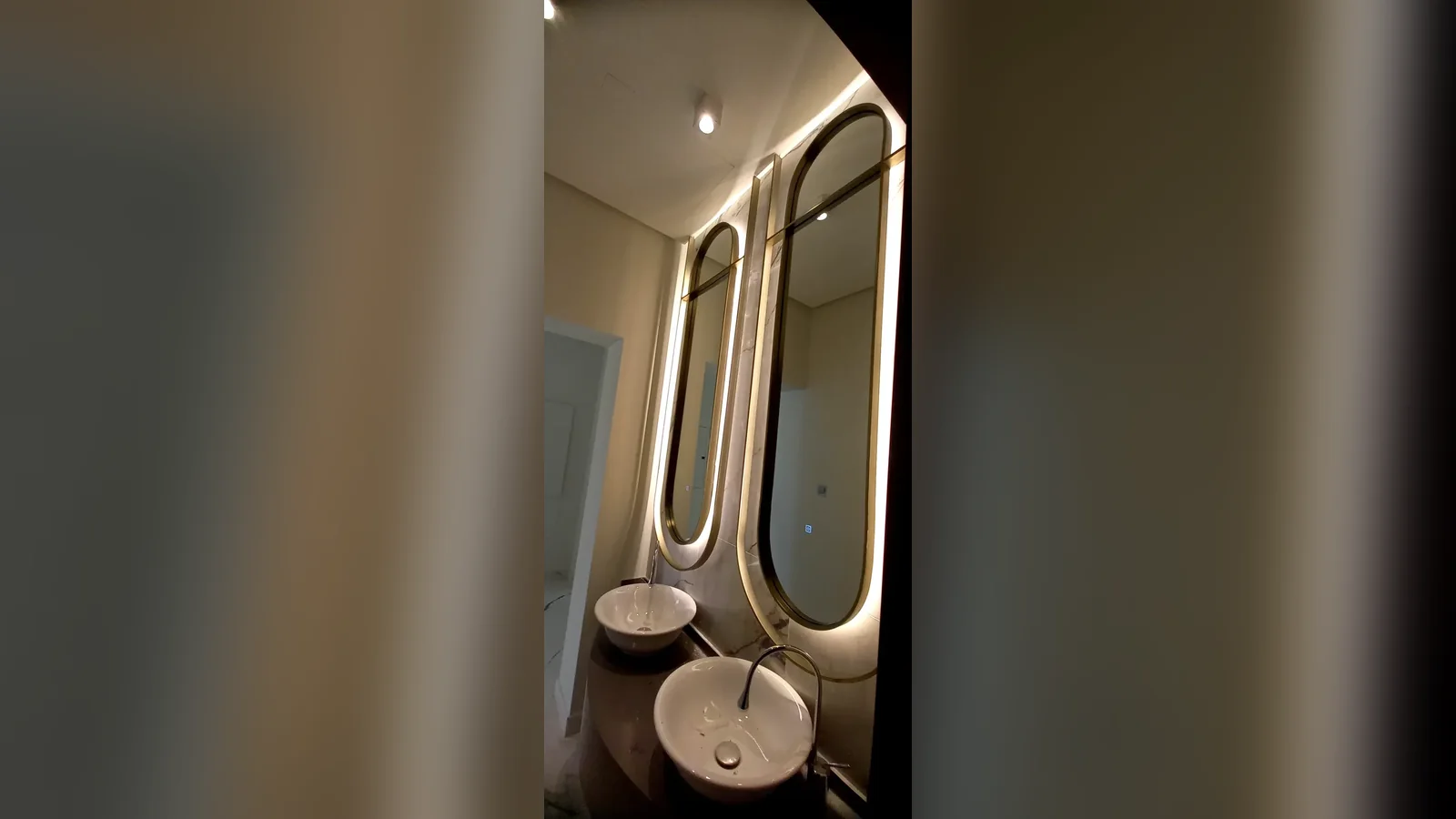
Anti-fog is most useful when:
- the mirror is close to a shower without a full-height enclosure;
- the bathroom has weak ventilation or no window;
- you use the mirror straight after a hot shower;
- a long vanity mirror would otherwise fog across its full width.
It is less important in a powder room or a dressing area away from steam. Also ask how the demister is switched. On some systems it runs with the lights, while on others it has its own control.
Controls: touch, switching and dimming
Controls are project-specific, so they should be agreed with the LED system rather than assumed. The common options are a wall switch, a touch sensor on the glass, or a sensor that also changes brightness or tone.
Questions to ask before ordering
- Will the mirror be switched from the wall, from the glass, or both?
- Can the brightness be dimmed for night-time use?
- If the tone is adjustable, how does the user change it?
- Does the anti-fog pad share the same switch?
- Where will the power feed and driver sit, and can they be reached later?
A touch sensor needs a clear area on the mirror face. Plan it away from the main viewing zone, and avoid placing it where a tap or shelf blocks easy reach.
Wet-area safety and the electrical point
A bathroom mirror sits close to water, so the LED parts, the driver and the protection level must suit its position. Blue Lake checks the LED, driver and protection requirements for each mirror location before fabrication. Mains connections should always be made by a qualified electrician to local rules.
Agree the electrical point early. If your bathroom is still being finished, fix the mirror size first, then position the power feed behind it. In a finished bathroom, the existing point becomes a limit the design must respect. Our article on planning a bathroom mirror around the vanity covers the layout side.
What affects the cost of these options
There is no fixed rate for light colour or controls, because every made-to-measure mirror is different. The main factors are:
- Lighting layout: a simple backlit glow and a decorative design use different LED work.
- Tone choice: a single tone is simpler than an adjustable system.
- Anti-fog: a demister adds a component and a connection.
- Controls: touch sensors and dimming depend on the selected LED system.
- Size, shape and frame: these still drive most of the fabrication work.
- Site conditions: wall condition, power position and access affect installation.
The simplest next step is to send a wall photo, rough dimensions and your preferred tone. You can contact Blue Lake for a project quote, and the final details are confirmed after site measurement.
Frequently asked questions
A neutral white tone is the most common choice for make-up, because it shows skin and product colours more evenly than warm light. If you also want a softer evening look, ask about an adjustable tone.
Neither is right for every room. Cooler light can make a small white bathroom feel brighter. Warm light makes it feel cosier. Match the tone to your ceiling lights and finishes.
Anti-fog is worth adding when the mirror is near a hot shower or the bathroom has weak ventilation. It matters less in powder rooms and dressing areas. Blue Lake offers it as an option.
Only if the selected LED system supports adjustable tones. A single-tone mirror keeps the tone it was made with, so decide before fabrication.
Yes. The 3D glass configurator lets you preview mirror shapes and approximate sizes. The preview is illustrative, and the final specification is confirmed after measurement.


